You need to know how buyers in your category decide. Agencies, survey panels, listening tools and AI data platforms all promise the answer, but they measure very different things. Here is what each one actually delivers, what it costs and when it is the right call.

Consumer research used to mean one thing: hire an agency, wait a few months, get a deck. Today the same budget can buy a survey panel, a social listening seat, a review analytics dashboard or a data layer your AI assistant can query.Days when online stores compete purely on the prices, number of SKUs, or flashy design are gone. In today's ecommerce, customers are overwhelmed by an endless sea of choices, looking for guidance to help them make the right decision.
The shift is being pushed by AI. In NIQ's September 2026 tracker, 51% of U.S. consumers said they had used at least one AI tool to shop in the past month. Buyers now research through assistants, and brands want their own research inside the same tools. Several of the providers below have already connected their data to Claude, ChatGPT or Copilot.This shift is accelerating with the rise of "Agentic Commerce." As users get comfortable with AI assistants and chatbots acting on their behalf, they increasingly expect online stores to function the same way. They want a "digital assistant" that understands their needs rather than a static list of filters. If your website doesn't offer this flow, you risk falling behind a rapidly changing consumer habit.
More options means more ways to buy the wrong thing. This guide compares 8 leading options, including our own, and is honest about where each one wins.A seamless shopping experience – where customers are effortlessly guided to the perfect product – can significantly increase conversion rates, average order value and reduce returns and abandoned carts.
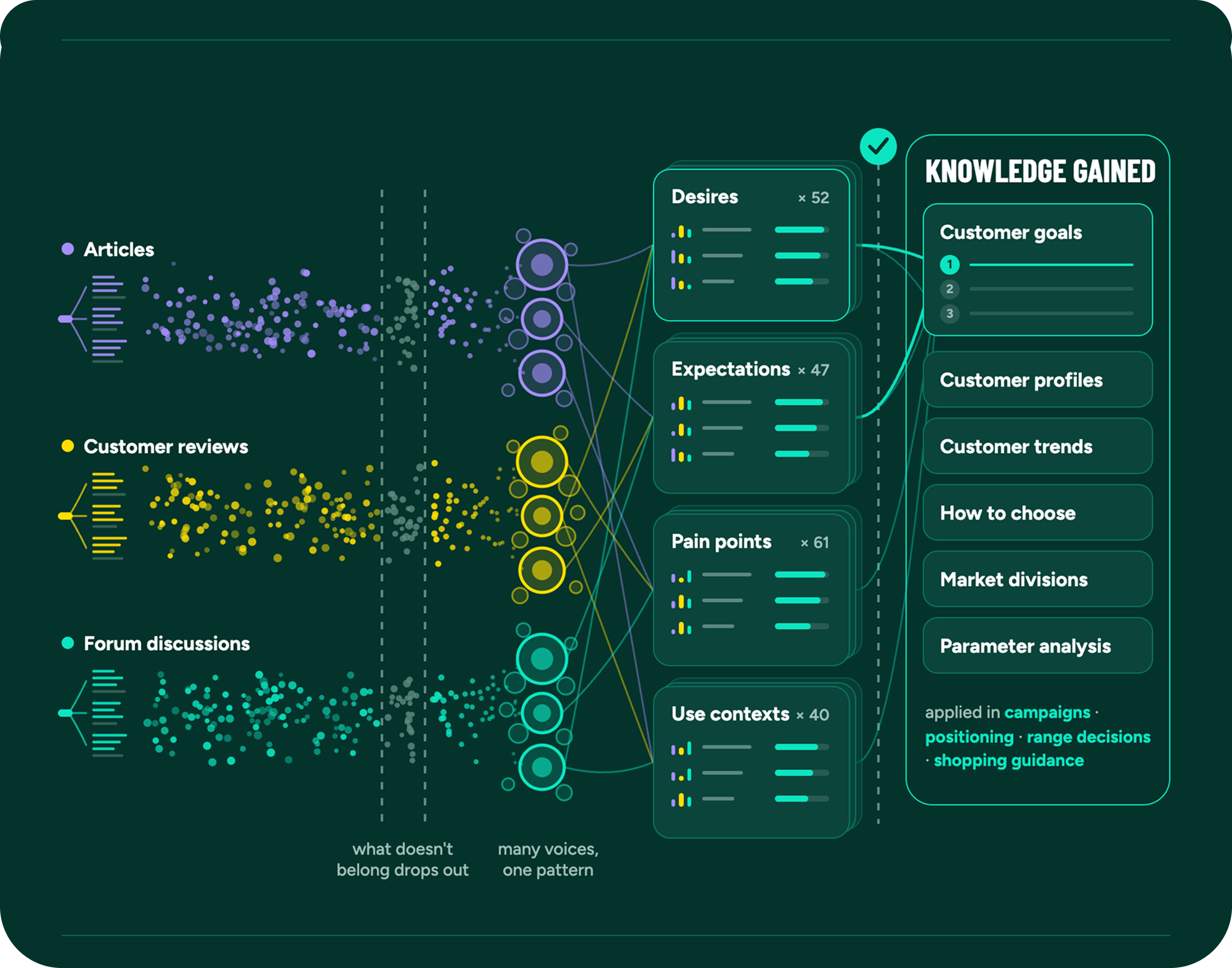
Most vendors describe their output as "consumer insights". That label hides very different products. Start with these four questions.When choosing guided selling software, consider your team’s resources and expertise. If you have the capacity to build a custom solution, you’ll need to manage everything from product data pairing to user experience design. This approach requires deep knowledge of customer behavior and expertise in product features.
What question are you actually answering?
- "How big is the market and who has share?" You need retail measurement or market sizing data.
- "Who is my audience and what do they do?" You need audience survey data.
- "Will this concept, ad or pack work?" You need a survey or testing platform.
- "What are people saying about my brand right now?" You need social listening.
- "What do buyers say about my products after purchase?" You need review analytics.
- "How do buyers in this category decide, and what do they need?" You need category decision research.
Most teams need more than one of these over time. Few teams need all of them at once.
Surveys and focus groups ask people questions. That gives you control, clean samples and numbers you can defend. It also limits you to questions you already thought of, and answers can drift from real behavior.
Listening tools, review analytics and discourse research observe what people say unprompted. That surfaces needs nobody thought to ask about. The trade-off: you only see people who chose to write, so samples are not representative in the statistical sense.
A classic project ends with a PDF. A growing number of providers now offer dashboards, APIs or MCP connections that let your team, and your AI tools, query the data on demand. Ask how the output will be used six months after delivery, not only on presentation day.
Most providers in this space quote per project or per annual contract, and few publish prices. Ask for the full cost of your first year, including extra categories, markets and seats.
There are three ways to buy consumer research, and each suits a different team.
- Commission a project. An agency designs and runs the study for you. Best when the decision is big, the question is new and you need methodology you can defend in a boardroom. Expect weeks to months and a project fee.
- Subscribe to data. You get access to an existing dataset: retail panels, audience surveys, market sizes or processed consumer discourse. Faster and cheaper per question, but you work with what the provider already collects.
- Do it yourself. Survey platforms and listening tools hand you the instruments. You write the questions or queries and do the analysis. Flexible, but the quality depends on your team's research skills and time.
Let's look at the leading providers, grouped by what they actually measure.
Best fit for
Businesses of all sizes looking for a ready-made, fully integrated guided selling solution that mirrors the behavior of an AI sales agent. Ideal for those who need seamless implementation and sophisticated customer behavior analysis without dedicating significant resources to in-house development.
Pricing
Starting at €99/month
Reviews
Free trial
Yes
Overview
Outfindo is designed for businesses that want a plug-and-play guided selling solution with minimal setup effort. With two proprietary AI agents, Beacon and Diver, Outfindo leverages customer insights to create a dynamic and personalized guidance flow, ensuring customers are matched with the right products based on their needs and desires.
It analyzes customer needs in real-time and matches them with complex product data, effectively bringing the agentic commerce experience to your store without the need for custom LLM (Large Language Model) integration.
The platform manages everything from product data sourcing, cleaning, and enhancement to pairing product attributes with customer queries, making it a complete, end-to-end solution.

Best fit for
Enterprise businesses seeking a customizable guided selling solution and willing to invest in a tailored experience with the resources to build and maintain the system.
Pricing
No public pricing; quotes seem to start at around €550 per month.
Reviews
Free trial
Yes
Overview
Zoovu is designed primarily for large enterprises that need a highly customizable guided selling experience. The platform allows businesses to build their own flow and manage their product data, offering flexibility in tailoring the solution to specific needs. Zoovu's AI can be trained using sample product groups, and over time, it learns to classify and enrich product data based on these examples, making it more scalable. This makes it best suited for businesses with the budget and capacity to handle complex configurations.
While Zoovu's flexibility and customization options are appealing, businesses' reliance on creating and maintaining the solution may be overwhelming for those lacking the necessary expertise or resources. If you have a clear vision for your guided selling experience and a dedicated team to set it up, Zoovu could be a great fit, but be prepared for a high upfront cost and the ongoing need for management and optimization.

Best fit for
Businesses that prefer a DIY approach or are looking for pre-made guidance templates for certain verticals to build their own guided selling experience.
Pricing
No public pricing; quotes seem to start at around €550 per month.
Reviews
Free trial
No
Overview
Neocom offers a guided selling solution that provides pre-made templates for certain verticals, helping businesses set up their own personalized experience. While this can be a great starting point, businesses are still responsible for managing their product data (cleaning, standardizing, and matching it with questions to make the guide effective). The flexibility of this DIY approach can be appealing for companies with the capacity to dedicate time and resources to setting everything up, but it may not be ideal for those looking for an easy, ready-made solution.
If your business has the budget and resources to manage data and customization, Neocom could be a good fit. If you’re looking for a solution that’s quick to implement and includes data management, you might want to consider fully integrated, ready-made platforms.

Best fit for
Businesses that want to experiment with AI and have the resources to train and customize their own guided selling tool.
Pricing
No public pricing; costs vary based on the features and setup.
Reviews
Free trial
No
Overview
Excentos offers an intuitive, DIY tool that allows businesses to build their own product advisor, either using a few pre-made templates and themes or by creating something entirely custom. The platform also includes AI capabilities, but to fully leverage this, businesses must create attributes, label sample products, and train the AI model to automate data management and product recommendations. This process requires substantial time, expertise, and resources, making it best suited for companies that want to develop their guided selling system hands-on.

Best fit for
Businesses looking for a chatbot-style solution that can answer a wide range of customer queries, from product specifications to customer service questions.
Pricing
No public pricing; limited information on cost structure.
Reviews
Free trial
No
Overview
Frontnow offers a chatbot-style solution that can address a variety of customer queries, from product details to customer service inquiries. While it excels in providing flexibility and conversational engagement, it comes with some limitations. Customers need to know exactly what to ask, which can cause confusion, and the system doesn't provide full transparency, leaving customers unaware of why a product is the best choice. Additionally, it doesn't display a range of products or integrate with product list pages, and while it can answer a wide array of questions, the guidance may not always be focused or highly relevant.

Best fit for
Businesses that want an intuitive, DIY tool to create their own guided selling experience with a smooth design and flexible customization.
Pricing
No public pricing, making it difficult to predict costs.
Reviews
Free trial
No
Overview
Crobox offers an intuitive interface that allows businesses to create their own guidance flow and manage product data. While it provides flexibility and a smooth design, businesses are still responsible for managing data sources and creating detailed filtering and ranking rules, which requires significant manual work. The lack of a free trial and the DIY approach makes it difficult to estimate whether the solution will work for your specific needs. You can invest time and resources into creating a seamless experience that benefits both customers and businesses, but there’s a risk that it may not fully align with your expectations or objectives once implemented.

Best fit for
Businesses looking for a straightforward tool to create their own product advisor without the need for advanced features or AI.
Pricing
Starting at €49.99/month, based on interactions, guides, SKUs, and features.
Reviews
Free trial
Yes
Overview
Confi offers an easy-to-use DIY tool for businesses to craft their own product advisors. The platform provides a free trial, allowing businesses to test the solution, experiment with the environment, and see if they can create a seamless guidance flow in-house. However, businesses still need to invest time in setting everything up. Without expertise in customer behavior, the guidance flow can end up being too shallow and product-centric, similar to traditional filters. This makes it a good fit for smaller businesses or those without complex needs, but it may not be ideal for businesses looking for advanced features or a fully personalized best-in-class experience.

While the tools above represent the most comprehensive guided selling solutions on the market, several other platforms deserve recognition for their specialized approaches.
Strong guided selling platform that excels at creating visually appealing product finders with both AI and classic modes, offering good balance between ease of use and customization. However, it focuses primarily on the guidance flow itself and doesn't include the comprehensive product data management and enrichment that Outfindo provides as part of its end-to-end solution.
Primarily known for AI-powered site search and product discovery, Luigi's Box recently launched its Shopping Assistant. The tool integrates well with their existing search infrastructure and offers a dialogue builder for creating guided flows. While promising for businesses already using Luigi's Box for search, the guided selling component is relatively new and lacks the deep customer behavior research and automated data management that more mature solutions offer.
An interactive content platform that offers product recommenders and guided selling as one of many interactive experience types (alongside quizzes, calculators, and gamified content). Dot.vu provides strong visual customization and a drag-and-drop editor that's accessible to non-technical users. However, its broader focus on interactive content means it lacks the specialized e-commerce features, product data intelligence, and conversion optimization capabilities of dedicated guided selling platforms.
A discovery suite that includes guided selling alongside site search, filtering, and recommendations. Tweakwise's guided selling module allows businesses to create question-and-answer dialogues that filter product results. While it offers good integration with the broader Tweakwise ecosystem, the guided selling component requires significant manual setup and doesn't include AI-driven customer insights or automated product data pairing found in more advanced solutions.
Focuses on AI-powered search and merchandising with personalized product recommendations as a core feature. While Maropost excels at smart search and dynamic product listing optimization, it approaches guided selling indirectly through recommendation widgets rather than dedicated question-based guidance flows. Best suited for businesses that want to enhance product discovery through intelligent search rather than interactive customer conversations.
An enterprise personalization platform that includes product finder templates and recommendation strategies among its broader optimization toolkit. Dynamic Yield's strength lies in sophisticated A/B testing and cross-channel personalization, but its guided selling capabilities are template-based rather than a fully-featured solution. The platform requires significant technical resources to implement and is primarily designed for large enterprises with dedicated personalization teams.
By now, the main difference should be clear: it comes down to whether you want a ready-made, agentic solution like Outfindo or if you are willing to invest significant time and resources into a complex, customizable platform like Zoovu or Neocom.
The best guided selling software should make the experience smooth and intuitive for your customers – connecting them with the right products quickly and easily, without needing to be an expert or spending too much time building the system.
Outfindo offers just that. It's a plug-and-play solution powered by AI that takes care of both the guidance flow and data management. All you need to do is upload your product feed and customize the look, and Outfindo's AI agents will handle the rest. You can even test it with a free trial to see how it works for your business. Ultimately, the choice depends on how much customization you need and how much time and resources you're ready to invest. The right solution will help you meet your goals without overcomplicating things.